Expert Content
One hour with a partner becomes a month of content
We interview one of your partners for an hour a month about the questions clients ask. That recording becomes answer pages for your website, short videos of the partner, and posts for LinkedIn and your Google Business Profile.
About 90 minutes of a partner’s time a month, review included.
Four client questions, answered by a partner:
- How much does a divorce cost?1 page · 2 videos · 2 posts
- How long does probate take?1 page · 2 videos · 2 posts
- Do I need a solicitor to remortgage?1 page · 2 videos · 2 posts
- What happens at a first meeting?1 page · 2 videos · 2 posts
What is expert content?
Expert content is material that comes from the person who does the work: the solicitor, the dentist or the adviser, speaking from cases they have handled. It answers the questions clients really ask, in that person’s own words, with their name on it and a date that shows when it was last checked.
It is the opposite of the generic article. Any firm can publish “five things to know about probate”, and any AI tool can write it in a minute. Only your partner can say what goes wrong most often in a probate application, what it usually costs at your firm, and what they tell a client on the first call.
The hard part has never been knowledge. It is time. A partner can answer a client question in two minutes of talking and will not find two hours to write the answer down. So we record the talking and do the writing.
See the month in 28 seconds
One question, one recorded hour, and what comes out of it. No sound needed.
- 0:00A client types a question
- 0:05The answer is in a partner’s head
- 0:10What one recorded hour becomes
- 0:17The two rules we do not bend
The questions in the video are examples.
Why does it have to come from the partner?
Three reasons, each with a source you can check.
of the citations in local AI answers pointed to the business’s own website, more than any other kind of source. What your site says in its own words is the first thing an assistant reads. Source: BrightLocal local AI visibility study, September 2026, 1.9 million citations, United States.
“Is it self-evident to your visitors who authored your content? Do pages carry a byline, where one might be expected?”
Google Search Central, questions to ask about your own content
“Fabricating creator profiles (such as by using AI-generated headshots, made-up names, or false credentials to make content appear as if it was written by human experts) is a form of deception.”
Google Search Central, the same page, updated 5 October 2026
Google asks three things of any page: who made it, how it was made, and why. It asks whether the content shows first-hand expertise, and it now names invented experts as deception that marks a page as low quality. A real partner with a real byline is the plainest answer to all of that.
The third reason is your regulator. In August 2026 the Solicitors Regulation Authority issued a warning notice on the misuse of AI. It deals with legal work and not with marketing, but its principle is the one we work to: the solicitor stays accountable for anything produced with AI.
Read this with care. No study shows that a partner’s name on a page makes an assistant cite it. The evidence supports something narrower. Assistants lean on firm websites, Google asks who wrote a page, and regulators hold the firm responsible for what it publishes. A real expert, named and checked, meets all three.
What one recorded hour becomes
Everything below comes out of the same 60 minutes. None of it starts from a blank prompt.
Answer pages
One page for each question, 600 to 900 words. The short answer comes first, then the detail, then fees or timescales where you publish them. Each page carries the partner’s name, their role and the date it was last reviewed.
Short videos
Two for each question, 30 to 60 seconds long, cut from the recording. The partner on camera, captions on screen, in vertical and square formats.
Posts
Four for the partner’s LinkedIn profile and four for your Google Business Profile. Each one points to an answer page.
Quote cards
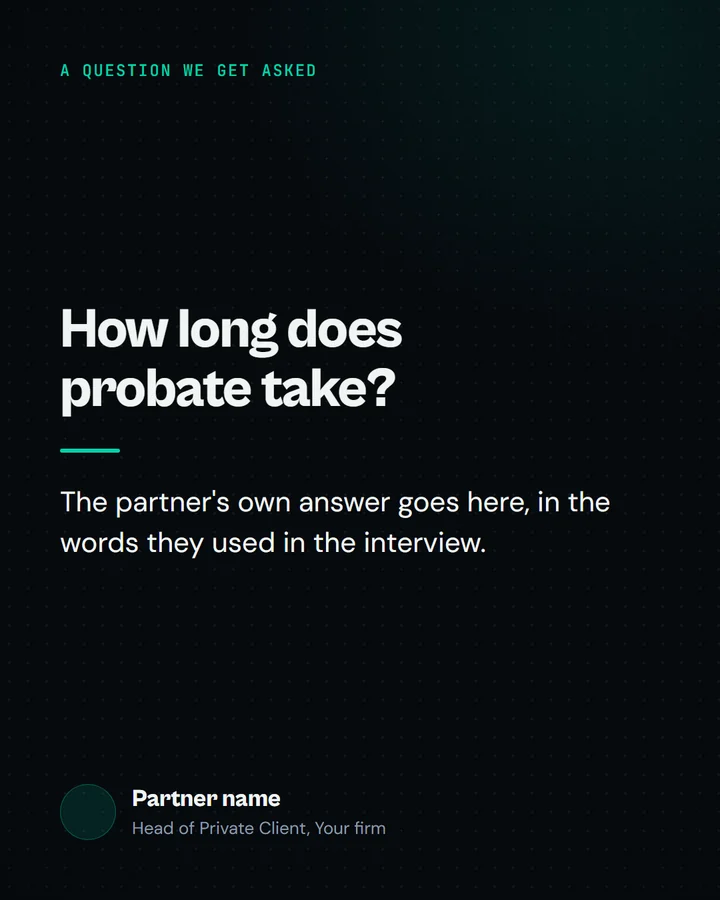
One graphic for each question in your firm’s colours, for the feed and for the top of the page.
How a month works
Five steps. The partner is needed for two of them.
-
Choose the questions
We bring a shortlist from your AI visibility check, your intake calls and the searches that already reach your site. You pick four.
-
Record the hour
A video call with one partner. We ask, and they answer the way they would answer a client. There is no script and no preparation beyond seeing the questions.
-
Draft and cut
We turn the recording into pages, clips and posts. AI makes the transcript and a first rough draft. A person edits every line against what was said.
-
Partner review
The partner reads the four pages and watches the clips. Changes come back as tracked edits, and your compliance contact signs off.
-
Publish
We publish to your site and profiles, or hand everything to your web team with instructions. The next recording is booked before the month ends.
How does this compare with other ways to get content?
There are four ways a firm ends up with articles on its website. They differ most in where the knowledge comes from.
| Compared on | AI-written articles | An agency writer | The partner writes | A recorded hour |
|---|---|---|---|---|
| Where the knowledge comes from | The model’s training data, which is the same for every firm. | A writer’s research. The writer is rarely a lawyer or a clinician. | The partner. | The partner, in their own spoken words. |
| Partner time each month | A review, if anyone remembers to do one. | A briefing and several rounds of corrections. | Hours for every article. | About 90 minutes. |
| Named author | Often nobody, or a name on work that person did not do. | Usually the firm. | Yes. | Yes, with their role and a review date. |
| Main risk | It reads like every other site, and nobody checked the errors. | Accurate but generic. | It does not get written. | It needs a partner who is willing to talk. |
What we need from you
An hour of one person’s time, somewhere quiet, and someone who can say yes.
Each month
- One partner for a 60-minute video call and about 30 minutes to review
- A laptop with a camera in a quiet room we send a short setup guide
- Your logo, colours and fonts
- An editor login for your website or a web contact who will publish for you
- One person who signs off for compliance
We never ask for
- Client names or matter details
- Your practice or patient management system
- The partner’s LinkedIn password posts arrive ready to paste
- Owner rights on any account
The rules we work by
The first two are not negotiable. They are the reason the content can carry a partner’s name.
A real person on camera
The partner appears as themselves. No avatars, no cloned voices and no generated headshots.
Nothing goes live without sign-off
Every page, clip and post is approved by the partner and by whoever handles compliance at your firm.
Only what was said
Pages are built from the recording. If we add a fact the partner did not say, it is marked for them to check.
No client details
The questions are general ones. Anything that could identify a client is cut before the first draft.
No ranking promises
We do not promise positions, citations or enquiries. We promise the content, on time and checked.
Everything stays yours
The recordings, pages, clips and posts belong to the firm, with no licence to renew.
What it costs
One monthly price, or a single session to see the output first.
Monthly
$1,497a monthOne recorded hour, turned into a month of content.
- One 60-minute recorded interview
- Four answer pages with the partner’s byline
- Eight short captioned videos
- Eight posts for LinkedIn and Google Business Profile
- Four quote cards in your firm’s colours
- Publishing, or a handover to your web team
Single session
$997one timeOne recorded hour, two answer pages, four short videos and four posts. A way to see the output before you commit to a month.
Try one sessionFree AI visibility check
$0Five client questions on three assistants. It shows which questions your website does not answer, which is where the first recording starts.
Get the free checkPrices are in US dollars. Transcription and editing costs are included. There is no setup fee and no minimum term on the monthly plan.
How many new clients would cover a month?
We do not forecast enquiries from content, and you should be wary of anyone who does. Pages take time to be found, and nobody can tell you in advance which one a client will read before they call.
What you can work out is how little it would take to pay for itself. Move the slider to what one new client is worth to your firm.
One new client at that fee covers the month.
Monthly fee $1,497. This is arithmetic, not a forecast.
If your firm is regulated
For solicitors in England and Wales, the SRA Transparency Rules already require price and service information on your website for certain services. An answer page is a natural home for it, written in the plain English clients search in.
Dental practices in the UK follow the General Dental Council’s guidance on advertising. Health practitioners in Australia cannot use patient testimonials about clinical care under the Ahpra advertising guidelines, which is one more reason the practitioner speaks and patients do not.
Every page goes to your compliance contact before it is published. We are not a law firm and this is not compliance advice. The decision stays with your compliance officer.
Common questions
Anything not covered here, ask on the call.
Related services
Sources
Every figure, quote and rule on this page, with where it came from. Checked on 11 October 2026.
- BrightLocal, local AI visibility study. Business websites made up 42% of the citations in local AI answers. About 200,000 searches and 1.9 million citations, United States. Published 16 September 2026.
- Google Search Central, Creating helpful, reliable, people-first content. The who, how and why questions, and the passage on fabricated creator profiles. Last updated 5 October 2026.
- Solicitors Regulation Authority, warning notice on the misuse of AI. Issued 17 August 2026.
- Solicitors Regulation Authority, Transparency Rules.
- General Dental Council, Guidance on advertising.
- Ahpra, Guidelines for advertising a regulated health service.
Find the questions worth an hour of a partner's time
The free AI visibility check shows which client questions your website does not answer. Start there, or book a call and we will plan the first recording.